I read the following article with this in mind: The Middle East has the bulk of the world's remaining oil supply. The United States is laying claim to this fuel for industrial society and the military power to control it. The price is what you read. And, the world is not at the "peak", let alone on the slide down the other side. The continuing price will only grow if this is the way the deciders choose it. Bernie
THURSDAY 16 APRIL 2009
Opinion
Iraq in Fragments
Sunday 12 April 2009
by: Dahr Jamail Visit article original @ Foreign Policy In Focus
Iraqi children, (L-R) Rebaz, 12, Omer, 7, Muhammad, 12, Hussein 7 and Imad, 11, who were injured during the Iraq war. (Photo: Reuters Pictures)
"[W]hat lengths men will go in order to carry out, to their extreme limit, the rites of a collective self-worship which fills them with a sense of righteousness and complacent satisfaction in the midst of the most shocking injustices and crimes." -Love and Living, by Thomas Merton
On Wednesday, March 25, Major General David Perkins of the U.S. military, referring to how often the U.S. military was being attacked in Iraq, told reporters in Baghdad, "Attacks are at their lowest since August 2003." Perkins added, "There were 1,250 attacks a week at the height of the violence; now sometimes there are less than 100 a week."
While his rhetoric made headlines in some U.S. mainstream media outlets, it was little consolation for the families of 28 Iraqis killed in attacks across Iraq the following day. Nor did it bring solace to the relatives of the 27 Iraqis slain in a March 23 suicide attack, or those who survived a bomb attack at a bus terminal in Baghdad on the same day that killed nine Iraqis.
Having recently returned from Iraq, I experienced living in Baghdad where people were dying violent deaths on a daily basis. Nearly every day of the month I spent there saw a car bomb attack somewhere in the capital city. Nearly every day the so-called Green Zone was mortared. Every day there were kidnappings. On good days there were four hours of electricity on the national grid, in a country now into its seventh year of being occupied by the U.S. military, and where there are now over 200,000 private contractors.
Upon returning home, I experienced the disconnect between that reality, lived by roughly 25 million Iraqis, and the surreal experience of living in the United States - where most media pretend the occupation of Iraq is either not happening, or uses the yardstick of decreased U.S. military personnel deaths in Iraq as a measure of success. In the words of Major General Perkins, "If you take a look at military deaths, which is an indicator of violence and lethality out there, U.S. combat deaths are at their lowest levels since the war began six years ago." But it's a less useful metric when one looks at the broader picture inside of Iraq: the ongoing daily slaughter of Iraqis, the near total lack of functional infrastructure, the fact that one in six Iraqis remains displaced from their homes, or that at least 1.2 million Iraqis have died as a result of the U.S.-led invasion and occupation of their country.
Seventy-two months of occupation, with over $607 billion spent on the war (by conservative estimates), has resulted in 2.2 million internally displaced Iraqis, 2.7 million refugees, 2,615 professors, scientists, and doctors killed in cold blood, and 338 dead journalists. Over $13 billion was misplaced by the current Iraqi government, and another $400 billion is required to rebuild the Iraqi infrastructure. Unemployment vacillates between 25-70%, depending on the month. There are 24 car bombs per month, 10,000 cases of cholera per year, 4,261 dead U.S. soldiers, and over 70,000 physically or psychologically wounded soldiers.
There 's no normal life in Baghdad. While it's accurate and technically correct to say there is less violence compared to 2006, when between 100 and 300 Iraqis were slaughtered on a daily basis, Iraq resembles a police state more than ever. U.S. patrols consisting of huge, lumbering mine-resistant vehicles rumble down streets congested with traffic. It's impossible to travel longer than five minutes without encountering an Iraqi military or police patrol - usually comprised of pickup trucks full of armed men, horns and/or sirens blaring. Begging women and children wander between cars at every intersection. U.S. military helicopters often rumble overhead, and the roar of fighter jets or transport planes is common. There's no talk of reparations for Iraqis for the death, destruction and chaos caused by the occupation.
Neighborhoods, segregated between Sunni and Shia largely as a result of the so-called "surge" strategy, provide a blatant view of the balkanization of Iraq. Neighborhoods of 300,000 people are completely surrounded by 10-foot high concrete blast walls, rendering normal life impossible. The fear of a resurgence of violence weighs heavy on Iraqis, as the current so-called lull in violence feels tenuous, unstable, and possibly fleeting. Nobody there can predict the future, and to hope for a sustained improvement in any aspect of life feels naive, even dangerous.
The title of the film "Iraq in Fragments" by James Longley, which was nominated for Best Documentary Oscar at the 2007 Academy Awards, best describes Iraq today. The country has been destroyed by decades of U.S. policy that has plagued Iraqis. Looking back only to 1980, we see the U.S. government supporting both Iraq and Iran during their horrible eight-year war. In 1991 we see George H. W. Bush's war against Iraq, and his, Bill Clinton's, and George W. Bush's oversight of 12-and-a-half years of genocidal economic sanctions that killed half a million Iraqi children. Today, under President Barack Obama, what is left of Iraq smolders in ruins, with no real end of the occupation in sight.
All of the recent talk of withdrawal from Iraq is empty rhetoric indeed to most Iraqis, who see the giant "enduring" U.S. military bases spread across their country, or the U.S. "embassy," the size of the Vatican City, in Baghdad. The gulf between the rhetoric of withdrawal and the reality on the ground spans the distance between Iraq and the United States, while the reality is pressed in the face of the Iraqi people each day the occupation continues.
Thursday, April 16, 2009


Thursday, April 2, 2009
Remembering and Lamenting
As we journey the road to peace and justice, new expressions of the human heart and mind blossom. The Veterans for Peace have been creating memorials for US soldiers killed in Iraq over the recent years by placing religious symbols in open public grass areas like a military cemetery. These extensive memorials are impressive, stimulating a sense of the numbers of people who have been killed fighting for the nation. The loss of life can move the soul to appreciate the reality of war.
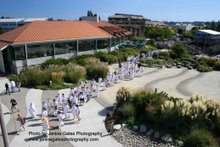
Now, we had the Iraq Memorial to Life. Here in Olympia Washington on the anniversary of the start of the Iraq war, we created a symbolic memorial to the Iraq persons killed since March 20, 2003. The memorials were in the form of markers which identified the person, often unknown by name, date of death, location. Each marker was handmade on authentic burial cloth shaped like a tombstone and laminated. These could be staked into the ground with a metal wire and spaced like a cemetery. We had nearly 4,000 markers, a mere fraction of the more than 90,000 deaths from the war which have been identified from newspapers, hospitals, or other documents in Iraq. The intention was to create one marker for each, but that was beyond our means at this time.
The Memorial did impress me and many others for its stark reminder that the war has been a horrendous experience. Each marker personalized a death, enabling the imagination to ruminate over a life cut short and relationships changed by the loss of a mother or father, son or daughter, grandparent, and friends.
I led meditations on both mornings of the Memorial. During the evening Vigil, the American Gandhi expressed the search for the real truth and the desire to express authentic love in this situation. This was a radical act here in the United States, which is still occupying and in some ways still at war with Iraq. I tried to put a face on the markers. Since the mainline media does not bring the faces to our attention because journalists are not going out to the Iraq communities, I went to the narrations of Kathy Kelly in her book Other Lands Have Dreams. Here are the first hand stories of the sick and dying during the sanctions which the UN says were killing 5,000 children each month. Kathy and other volunteers from Voices in the Wilderness were there and they were there when the invading troops arrived in Baghdad in 2003.
The Iraq Memorial to Life is now available to be transported and shown in other cities. We must be made aware of war and its consequences in this age of modern weapons which kill at the rate of 90 % civilians, a reversal of the 10 % killed at the turn of the 20Th Century. More information can be had by going to www.IraqMemorialToLife.org.
Having recently returned from Vietnam where I saw the continuing effects of Agent Orange and dioxin to the third generation, I felt very sensitive to the fact that our memorial was showing only a part of the death scenario. We did not highlight the sanctions effects between the 1991 Iraq war and the 2003 War. Further, we did not mention the effects of depleted uranium which will go on killing indefinitely.
Friday, March 13, 2009
Merton's Peace, Our Peace
Thomas Merton quoted Clement of Alexandria in his autobiography, Seven Story Mountain, published in 1947 stating that Christians are "an army shedding no blood." Merton was therefore on record that he was part of that army, consequently a peace advocate, a soldier for peace. Merton's story grew impressively over the years as he found that he was called as a monk to love the world, to love nature, to love all people. The monk does not flee the world, although that motivation can be mixed into the original thoughts at the entry of the monastery. The monk is a human finding a way to God and life through contemplation in solitude so that he or she can find truth about all creation in love and compassion. Merton's classic on peace, Peacemaking in a Post Christian World, was published in the 1990's. He died in 1968. He journeyed as the world grew deeper and deeper into the nuclear age. He became a light in the darkness.
That light still burns brightly as people seek the insights and wisdom from Thomas Merton's journey. I attended the Thomas Merton Society of Canada's annual conference on "Peace -- A Transforming Vision" last weekend. Jim Forest gave two keynote addresses beginning with the Clement of Alexandria quote. The weekend was full of workshops and presentations by people who carry on Merton's broad range of relationships and insightful communications. I attended a workshop on Merton and Rilke poetry, "at the Pivot of Silence," and "Thomas Merton at Gaza." The one a vivid exercise on the common contemplative expressions drawn from the wordless and the other a piercing presence into the anger, rage, frustration of Israel and Palestinian confrontation sum up the influence of Merton's life.
My journey has been guided in no small way by the wisdom of Thomas Merton.
The International Thomas Merton Society will conduct a Conference June 11-14 at Nazareth College in Rochester New York: BEARING WITNESS TO THE LIGHT, MERTON'S CHALLENGE TO A FRAGMENTED WORLD.
Maria Rilke's Poem
Breath, you invisible poem!
Pure, continuous change
with all that is, flow and counterflow
where rhythmically I come to be.
Each time a wave that occures just once
in a sea I discover I am.
You, innermost of oceans,
you, infinitude of space.
How many far places were once
within me. Some winds
are like my own child.
When I breathe them now, do they know me again?
Air, you silken surround,
completion and seed of my words.
A Poem by Merton:
"Love Winter When the Plant Says Nothing"
O little forests, meekly
Touch the snow with low branches!
O covered stones
Hide the house of growth!
Secret
Vegetal words,
Unlettered water,
Daily Zero.
Pray undistracted
Curled tree
carved in steel--
Buried zenith!
Fire, turn inward
To your weak fort,
To a burly infant spot,
A house of nothing.
O peace, bless this mad place:
Silence, love this growth.
O silence, golden zero
Unsetting sun
Love winter when the plant says nothing.
Monday, March 2, 2009
The victims of nuclear weapons tests
On March 1, 1954 the United States military tested a thermonuclear weapon on the Bikini Atoll in the Marshall Islands which was the most powerful nuclear weapon ever exploded by the US and exceeded the five megaton blast expected by the scientists by ten megatons. US military personnel, Japanese fishermen, and Island residents still suffer the effects of that weapon. The environment will carry the radiation and scars indefinitely.
On March 1, 2009 eleven of us were arrested at Sub Base Bangor on the Hood Canal in Washington State to commemorate the 55Th anniversary of the Bikini Atoll blast and to express our concern about the victims and the environment. The Navy base at Bangor houses the most powerful nuclear weapon on earth, the Trident Submarine., nine of them and 1500 nuclear bombs.
The Pacific Life Community held its retreat during the weekend and concluded it with this citizens intervention on behalf of life for all people, every species on earth. We commit ourselves to nuclear abolition, abolition of war, life as life is intended.
Next year, 2010, the United States has the opportunity to participate in the United Nations Non Proliferation Treaty meeting. At the last meeting, the United States maintained a token presence which told the world the US did not support nuclear abolition. Next year, either the US will support the Treaty or other nations will proliferate nuclear weapons in response.
We, citizens of the United States, must tell the government (and the world) that we want nuclear abolition.
On March 1, 2009 eleven of us were arrested at Sub Base Bangor on the Hood Canal in Washington State to commemorate the 55Th anniversary of the Bikini Atoll blast and to express our concern about the victims and the environment. The Navy base at Bangor houses the most powerful nuclear weapon on earth, the Trident Submarine., nine of them and 1500 nuclear bombs.
The Pacific Life Community held its retreat during the weekend and concluded it with this citizens intervention on behalf of life for all people, every species on earth. We commit ourselves to nuclear abolition, abolition of war, life as life is intended.
Next year, 2010, the United States has the opportunity to participate in the United Nations Non Proliferation Treaty meeting. At the last meeting, the United States maintained a token presence which told the world the US did not support nuclear abolition. Next year, either the US will support the Treaty or other nations will proliferate nuclear weapons in response.
We, citizens of the United States, must tell the government (and the world) that we want nuclear abolition.
Saturday, February 7, 2009
Updating
Here we are over a month into the new year, 2009, and going on three weeks since Obama's inauguration, and now four week since I've returned from Vietnam. So much is happening, these weeks seem like a lifetime. Just keeping up with events and coping with actions and possibilities is a stretch. The main thing for me is that I have recovered from the Vietnam trip! Not really, but it feels good to be recovered.
Several threads make up my present involvements, all in keeping with my mission/message of the last few years. Working towards an end to War making, especially nuclear war; overcoming Global Climate Change; and the effects of Peak Oil remain my top three priorities. I have raised up Climate Change and Peak Oil to just a little over war making. These humanly caused realities vie with each other for the lead. I don't think you can separate one from the other, as humans intentionally and unintentionally mix them.
Following up from the Vietnam trip, I continue to study and research why humans sacrifice other humans. While I diligently study Ernest Becker's Escape From Evil with its piercing insights, I find other complementary sources for insights. One interesting one is that Becker reflects on William James' essay "The Nonviolent Equivalent to War," written in 1906. That is the same year that Gandhi came up with his "satyagraha" method, which he tittled "the nonviolent equivalent to war!" When I finish this study, I will have to decide how I can use the insights. One possibility is to combine some with my photos from Vietnam. Few people realize that the bombing of Vietnam with Agent Orange is massive, the greatest use of chemical weapons in history. 3,000,000 suffer the effects today. I feel deeply thinking about the babies, children, and adults I've seen. Then, this compares with the effects on the peoples of Hiroshima and Nagasaki, not to mention the victims from all the nuclear bomb testing. We can go on to the radiation of "depleted uranium" in Iraq, the Gaza Strip, and elsewhere.
What about Climate Change and Peak Oil? To make a long narration short, I went to see what Richard Heinberg's latest is. He now works at the Post Carbon Institute (google it). Reviewing the site and the series of videos "Why all the things are going wrong"," has moved me to re prioritize, rather go back to my priorities of the last few years.
So, I'm regrouping and reorganizing. If anyone wants to make comments, critiques, suggestions, etc, go to it. Thanks.
Friday, January 23, 2009
Chaos as "Opportunity"
Today is the 14Th day since I returned from Vietnam. I am going through a many faceted reentry. First, of course is the recovery from the jet lag and red eye flights from Vietnam and Korea. This has been complicated by a head cold which started in Vietnam, and which I thought was cured there, but has not ceased. Second, I am still thinking about the whole experience of the victims of Agent Orange. The stated need by VAVA (Vietnam Association of Victims of Agent Orange) is US and chemical company assistance for the victims, including an apology. Third, I am reviewing and analyzing the issue of "sacrifice." Why do humans sacrifice their own people and their enemies as was done with Agent Orange, but is done in all wars? Fourth, the economic meltdown is demanding every one's attention. I have been spending some time going into that since it is affecting me and family members. Back to the first named, my energy is gradually returning.
My sense is that "we are in deep trouble." Analysts, including both the new President Obama and the past President Bush, do not have a handle on the economic meltdown. The word "Great Depression" was mentioned by Bush in his closing press conference (See Tom Englehardt's comments in Truthout.org) and creeps into conversations with a number of sources. No one wants to name it with certainty. Yet, the sense of the words that I am receiving is that this may be even more devastating or unwieldy (I'm reaching for the right words here) than the Great Depression. Those who have been reading this blog for the last nearly two years know that things are even more involved than the economy. How do you be "real" or "realistic" in this situation, without panicking or going into pessimism? I'm trying to name the elephant in the living room without the pessimism. But, no one knows the name of the elephant!
I return to Richard Heinberg's hope: After the 21st Century, one hundred years from now, whoever survives could live in a more human world, a more congenial civilization. We have the know how for that due to insights into human nature garnered of late. We also have the capability to continue laying waste to Mother Earth and each other.
I just read an article in the current issue of The Journal of Psychohistory about the effects of the Black Plague in the 13Th and 14Th centuries. The flux in all the facets of the way of life at that time enabled the survivors to make many gains in social relationships and in human life conditions. This was like the Chinese meaning of "chaos", i.e. opportunity. The normal patterns went out the door when the plague entered. Change happened.
Does not this remind us of what is happening on a small scale at this time, so far? A black president promising change has been elected and his/our opportunity has been "enhanced" due to all the issues raining down upon us: economic melt down, global climate change, wars, resource depletion.
I am still taken up by the human and environmental sacrifice due to Agent Orange in Vietnam and will do what I can to support the peoples there and here (our veterans and their families.) However, I must connect that reality to the others. This is our "opportunity." For me, the opportunity requires forming a deeper faith and discipline of will.
Sunday, January 4, 2009
War Museums
Today, January 5th, we begin our next to last day in Ho Chi Minh City and on our tour. I have not shared the War Museum experiences in Hanoi, Hue, and here in HCMC. The museums go back to the historic 1000 year period of Chinese control of Vietnam, from the beginning of AD to 1000 AD, and they touch uppon the various exploits in the second millemium. But, the major emphasis is the Indochinese war with the French, the post WW II peiod when the French were supported by the United States until they were defeated in 1954; then, the United States exploits culminating in the Vietnam War ending in 1975. The museums show the histories from a Vietnamee point of view as is expected.
For me, the visits are a review, almost a reliving of the history, especially from 1965 to 1975 when I was becoming involved in social activism, moving from supportive to US policy to radical desent and resistance. As the museum show quotes of US Senators that US policy of Vietnam violate the Geneva 1954 Peace Accords, the UN Constitution, and US Constitution, I also feel like "this is just like the Iraq war." Not really a surprise.
The museums begin outdoors with huge displays of captured US weaponry, aircraft, and tanks, and go to documemtaries, photo exhibits, models, etc of all types. There are even prisons and tiger cages. And, some were from the Diem regime in South Vietnam. Of course, the role of Ho Chi Minh and the North Vietnam military are given central focus for saving and liberating Vietnam. (We will return to the HCMC museum today to see the Agent Orange documentary.)
The self immolation of the Buddhist Monk protesting the oppression of the Buddhists by the Diem regime is shown with photographs which I remember from 1967. The execution of the Viet Cong prisoner by a South Vietnm officer in Saigon, and the girl stripped by napalm are captured by historic photos, among numerous other experiences are also shown. However, there is no mention of the witness of Thich Nhat Hanh, the Buddhist monk who spoke against both sides in this conflict, advocating peaceful resolution, and being sent into exile in 1966, only to return to Vietnam for the first time in 2005.
Yesterday, we visited the Co Cui tunnels outside of HCMC where the villagers lived from 1954, resisting first the French, then the Americans, until 1975. We crawed through a tunnel and saw a way of life that harrassed the militaries in amazing, and grusome fashion. Now a tourist site, the transformation exploits the war situation for economic and "educational" purposes. Our tour guide is from this area and is a sincere Buddhist. We enjoyed our visit to his home and fine lunch served by his family.
Subscribe to:
Posts (Atom)